
The physician shortage will worsen – unless Congress acts now
Congress has an opportunity to reverse the worsening physician shortage and bolster access to care for millions of people.

Congress has an opportunity to reverse the worsening physician shortage and bolster access to care for millions of people.
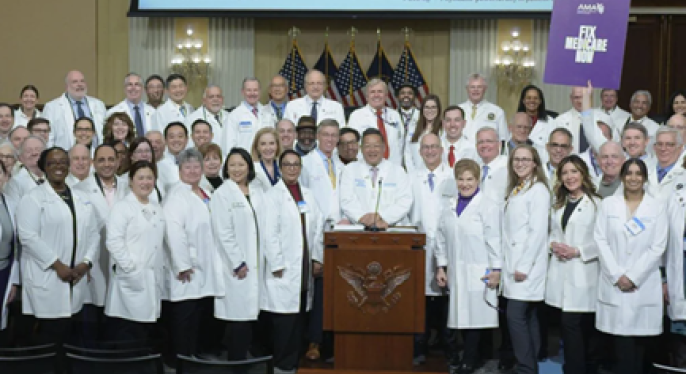
Bipartisan support for Medicare reform is building in Congress, as physicians witnessed firsthand at the 2025 AMA National Advocacy Conference.

Another year, another cut to the Medicare payments needed to keep physicians and their practices going. Congress must turn toward long-term reform.
Orthopaedic surgeons understand how important Medicare is to the people we serve, and most physicians remain committed to caring for Medicare patients. But it is unrealistic to assume practices can absorb reductions year after year without consequences. If this trajectory continues – and these latest proposed cuts suggest they might – there will soon come a day when more practices limit the number of Medicare patients they accept, stop offering certain services or leave the Medicare program altogether.
When adjusted for practice-cost inflation, Medicare physician payments have dropped 33% over the past 25 years, according to the American Medical Association.Compounding Medicare cuts have forced many physicians to opt out of independent practice, sell to larger institutions or retire early. Many physicians have stopped accepting new patients with certain Medicare plans, exacerbating the healthcare access crisis.
A well-documented paper from the Pacific Research Institute (PRI) found that over the past 25 years, doctor payments in the Medicare program failed to keep up with inflation and fell well below market value. In inflation-adjusted terms, Medicare reimbursements for physicians are down 33 percent over the past 25 years, with Medicaid payments following the same downward trajectory. These unrealistic payments are having serious consequences on the supply of health care. Doctors are retiring early; students are dissuaded from entering the medical field; private practice is financially discouraged; and ultimately the country faces a looming doctor shortage.
Over the last two decades, Medicare reimbursement to physicians has been on a steep decline; today, it’s 33% lower than in 2001, even after accounting for inflation. Without reimbursement that matches inflation, physicians must make difficult choices to adjust to rising costs. Many can’t afford to take any more Medicare patients, and some are compelled to leave independent practice altogether, closing their doors or selling to hospitals.
In inflation-adjusted terms, Medicare reimbursements for physicians are down 33 percent over the past 25 years, with Medicaid payments following the same downward trajectory. These unrealistic payments are having serious consequences on the supply of health care. Doctors are retiring early; students are dissuaded from entering the medical field; private practice is financially discouraged; and ultimately the country faces a looming doctor shortage.
Providing care to patients is becoming more difficult in the United States as more physicians are forced to limit or stop seeing patients on Medicare because of lower and lower reimbursement for physician services. The cost of running a medical practice continues to rise while physician reimbursement from Medicare has steadily fallen behind. This is not sustainable, and the patients’ access to care will suffer as more and more patients need care from a smaller number of physicians providing it.
When was the last time you saw a doctor? How long did you have to wait for an appointment? How far did you have to drive? For many Americans, accessing local care is becoming increasingly difficult. As a physician, I want to treat all my patients as early as possible, when their conditions are more manageable and complications are more likely to be prevented. Longer wait times and fewer care options are frustrating for doctors and patients alike.
The Trump administration has released Medicare's proposed physician payment rule for 2027. Buried in the hundreds of pages of technical regulations is a familiar outcome --- another cut in what physicians will be paid to care for seniors. Under the proposal, Medicare's basic payment rate would fall by as much as 1.7%.
U.S. Senators John Boozman (R-AR), Peter Welch (D-VT), Roger Marshall M.D. (R-KS), Angus King (I-ME), Thom Tillis (R-NC) and Jeanne Shaheen (D-NH) introduced the Provider Reimbursement Stability Act to modernize Medicare’s Physician Fee Schedule (MFPS). The bipartisan, comprehensive legislation would create greater predictability in Medicare physician payments, preserve patient access to care and better reflect the actual cost of delivering medical services.
We’re dedicated to raising awareness of Medicare physician payment system problems so that we can work towards solutions that protect physician practices and patients’ access to care. It’s vital that patients and physicians use their voices to advocate for change.
Click the button below to learn about the various ways to get involved in the fight to Fix Medicare Now.